
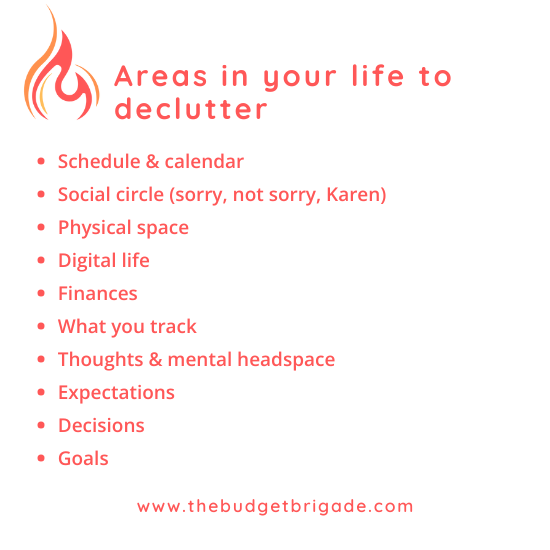
Living surrounded by clutter can leave you stressed, overwhelmed, and exhausted. It can also leave you feeling dysregulated. Coincidentally, when you feel unsettled and stressed, you’re more likely to lean into bad habits such as emotional shopping to help cope, which can create a nasty circle of clutter that feeds to more clutter and leaves you even more stressed (and broke). While you may not directly associate clutter with money, clutter can directly and indirectly impact your finances and your mental wellness, which in turn influences how you spend money. You don’t have to become a minimalist like me (though I welcome you to join the club!), but decluttering can help everyone. Below is my checklist of areas in your life to declutter.
Clear your schedule and calendar
Decluttering your schedule will make time for the rest of our decluttering focus areas below, so I recommend starting here. Even if you can’t purge everything everywhere all at once, any progress made will help prevent overwhelm. Decluttering is a process that requires commitment, but trust the process. I promise, it’s worth it.
I’m the first to admit I overcommit, and it leaves me exhausted and feeling like I’m not accomplishing what I want. I’m a work in progress when it comes to decluttering my schedule, but I’m leaning into it, especially in this busy season of life. I love spending time with family and friends, and I often feel guilty or FOMO for turning down an invite, but too much of a good thing is real. When I overcommit, I often feel annoyed with other people, even though I should be annoyed at myself.
Earlier this year, a friend told me she leaves one day every weekend empty on their family calendar. She purposely plans to not make plans. I loved this idea so much I stole it.
In order to say yes to focusing on your goals, financial or otherwise, you have to learn to say no to other things to give you time to work toward them.
Examine the following areas and see where you can optimize your time to better suit your life, career, and financial goals:
- Your work commitments (you probably can’t quit work, but maybe you’re in a position to scale back a bit, or look for a job with a shorter commute, etc.)
- Standing workouts, exercise classes, or lessons
- Recurring social plans (maybe consider every other week versus weekly or quarterly versus monthly)
- Events you feel obligated to attend but don’t enjoy
- Extended family events and traditions
- Volunteer roles
- Classes, clubs, sports, and other extracurriculars (both for you and coordinating for your kids)
- Screen time (social media, TV, etc.)
Pro tips:
- See where you can couple certain tasks together to save time. For example, I’m typing this on my treadmill to get exercise while also working on my entrepreneurial goals. I went for a walk earlier with a friend to catch up, and am now finishing my exercise for the day while I work.
- Also see if you can pull together carpool duties or swap out responsibilities with other parents to lighten your calendar for pick up/drop off and oversight duties.
Audit your social circle
This might sound harsh, but there’s power in quality over quantity. If we’re being honest, there’s probably at least one person in your friends group that you like but you don’t really connect with, or with whom it’s a hassle to stay connected because they moved out of town, etc. Bye, Felicia.
Other times, you have energy vampires to vanquish. These are the people who leave you drained every time you interact with them. Everyday life is exhausting enough without willingly subjecting yourself to this intentionally. Say bye bye to Karen and send her on her way.
Declutter your physical space
This is probably the most obvious and yet one of the most important. Being surrounded by stuff can distract and overwhelm. Growing up, I was surrounded by clutter and was also constantly anxious. Coincidence? Maybe a little, but the clutter didn’t help. It’s hard to stay focused and driven when you’re in a rush and can’t find your keys. Having a lot of physical clutter can also cause you to buy stuff you don’t need because you can’t find what you already own. This includes both your workspace and your home, but let’s focus on your home for now.
If you’re new to decluttering, here are a few of my favorite books to help organize and purge:
- The Life-Changing Magic of Tidying Up by Marie Kondo
- The Home Edit: A Guide to Organizing and Realizing Your House Goals by Clea Shearer and Joanna Teplin
Not a big reader? Check out the related shows on Netflix instead.
If you’re trying to cut back your spending on streaming subscriptions, check out The Home Edit Instagram account instead.
There can be so much physical clutter, this topic warrants its own article. Until I have time to write that though, here are some key focus areas where you’ll see the most change and thus reap the greatest rewards:
- Clothing & linens
- Papers
- Books & other physical entertainment
- Electronics
- Hobby stuff, sports equipment & toys
- Sentimental items
- Furniture & décor
As you’re decluttering, see what you can sell on Facebook Marketplace. This can help if money is tight and you’re looking for ways to increase your income.
A lot of brands that focus on organizing (including the Home Edit) will have expensive systems you can buy to organize, but these aren’t required. You don’t have to spend money to organize as you purge. Clearing out stuff you don’t use by nature helps organize what’s left. And having everything organized can help lower anxiety and stress levels (and save you time searching for those keys).
Declutter your digital life
This is another huge category I’d love to break down eventually because we spend more and more of our time online, but for now focus on:
- Your phone, especially apps and extra especially ones that you spend too much time on
- Photos and videos on your phone, computer, cloud storage, etc.
- Your notifications. Try turning them off but not on again. Pings for every email, Facebook alert, text, and Instagram like can be a killer of any and and productivity or peace.
- Your social media accounts. I think we all probably spend too much time on this, myself included. Try going on a social media sabbatical and see how it feels. It’s often hard to go back once you do and can free up so much time.
- Your email. I don’t know why but having a bunch of unread emails stresses me out. Maybe because they feel like little nagging remembers of things I haven’t looked at and need to do? Take a few minutes (or an hour) to go through and unsubscribe from every mailing list you never signed up for.
- Your downloads folder on your computer/tablet/phone. This is another one that overwhelms me when it piles up. I don’t even remember what half the shit is for or why it ended up in there in the first place.
Declutter your finances
Money nerds of the world, rejoice! Your time on this list has come. Non-nerds, never fear; this one isn’t as scary as it might sound, and it will probably save you a ton of frustration and boredom in the future. Some key ways to declutter your finances and free up some brain power include:
- Automating as much as you can: bill payments, retirement contributions, whatever you can make work so you don’t have to think about it.
- Doing an audit of your budget (or creating a budget if you don’t have one yet) and seeing what you’re spending that you could save instead. Subscriptions, I’m looking at you. Try taking our subscription challenge.
- Condensing multiple accounts into one, such as bank accounts (checking and savings), credit cards, and retirement accounts. It’s time to finally rollover your 401(k)s from your last five jobs.
Once you’ve culled the herd, don’t mother hen the remainders. AKA don’t repeatedly check in on your investments. Watching the ups and downs of the stock market is enough to make anyone motion sick and can consume your mental space. Limit check-ins to about once a quarter, max.
Declutter your tracking
There is so much data at our fingertips and, like Mr. Monk said, it’s a gift and a curse. We can get so caught up in tracking our movement and calories and activity that we barely have time for anything else, including life.
Go a day without your step counter. Don’t log your food, macros, or calories for two. Don’t obsessively check in on the cameras at home or at your kid’s daycare. Tell your watch it’s none of its business how well you sleep this week. Let your energy level be the sole judge of that. Don’t stress about counting your ounces of water today.
Keep track of your spending with your budget, but even here, let’s have some limits so it doesn’t consume you. Perhaps reduce the frequency a little, especially if it feels overwhelming.
Declutter your thoughts and mental headspace
If you’ve decluttered the areas above and are still FINE (freaked out, insecure, neurotic and emotional), it’s time to turn inward and find tools to declutter your mind.
Carve out ten to twenty minutes a day to meditate, even if it’s right as you’re lying down to sleep (this is what I do). I thought this was all woo-hooey like chakras and crystals, but it’s helped me with insomnia, and nothing kills productivity like exhaustion. My husband sets a repeating block on his calendar with a time each day to sit and meditate.
You don’t need expensive apps. Some companies give free subscriptions to apps like Headspace as an employee benefit, but if you need options that won’t bust your budget, I love the free version of InsightTimer.
Declutter your expectations
Still feeling stressed or missing contentment in your life? Let’s continue to focus inward and look at our expectations.
This is a big one that social media drives because it paints a panacea of perfection that’s impossible to obtain. And yet, we’ve programmed ourselves to believe we should try. We do it with our physical looks, our Pinterest homes, what we expect from others, and even what we expect from ourselves.
My husband and I have found a secret to happiness: low expectations. With low expectations, you aren’t pissed off when people inevitably don’t meet high expectations, or you’re pleasantly surprised if they do. This has saved us so much energy and unhappiness.
If you’re someone who naturally has high expectations, especially for themselves, this can be a hard left turn mentally. I snagged the audiobook of How to Be Enough by Ellen Hendriksen and found it super helpful toward this mind shift.
Declutter your decisions
Analysis paralysis is a real drag and a time suck. Sometimes the most time-consuming part of dinner for me is figuring out what to make.
As a species, we crave structure. Find ways to add structure to your life that ease the overload of decision making while also not making you feel confined. Structure should feel helpful, not restrictive.
Some areas to consider & tips to conquer them:
- What to eat: Put together a weekly meal plan using a core rotation of recipes you cycle through. This is one of our cornerstone meal hacks for tired moms (and dads). I eat the same thing for breakfast every day—a blueberry banana smoothie with hemp seeds and sunflower butter—and my husband rotates between oatmeal and berries or yogurt and berries.
- What to wear: As you declutter, consider downsizing the number of clothes you own (maybe even consider a capsule wardrobe). I loved having a uniform when I worked in aviation. I had four identical company polos and pairs of pants. No need to over analyze my clothing first thing in the morning, especially since no one cared what I wore.
- What to do: Set aside specific times of the day or week for important tasks, such as meditating. Have a locked in family game night once a week to ensure you have time to connect. This looks different for everyone, but the goal is the same: take the guesswork out of your day so you don’t spend all day trying to guess what to do.
- When to work on a specific task or goal: If you’re trying to get or stay fit, set a favorite workout time. If you’re working on building a new skill or studying for a new career, schedule that time like it’s a college course you have to attend.
- Who to listen to: Sometimes decisions are hard because there are too many chefs in the kitchen banging on pans trying to get your attention. Be selective about who gets a voice in your decision making process, then ignore the rest to prevent information overload. This includes Reddit and ChatGPT!
The more you can schedule (without overwhelming your schedule, because we just decluttered that!), the less thought you have to put into getting around to it and the more energy you can spend on actually doing.
Declutter your goals
While it’s great to have goals to guide you, having too many goals, especially ones that are unrealistic, can hurt more than they help and can leave you feeling like a failure even when you’ve accomplished a ton. This is a fast track to burnout.
When I was working on my last book, I killed myself trying to reach arbitrary goals I set. I was so focused on goals, I lost track of the focus of the goals and what I was trying to achieve.
I only found peace when my therapist reminded me that as I made goals, I needed to focus on optimizing for the right thing. I had to step back and reassess what really mattered. For me, this was writing because I enjoyed it and wanted to share my story. It was NOT writing because I HAD to get 3,000 words written or edited that day, which was my goal.
I found that, by setting less goals, I ironically became more productive because I didn’t get dejected for each goal I missed, and I wasn’t so exhausted from pushing myself so hard to reach those pointless benchmarks.
The final word
Decluttering is hard. It takes an upfront commitment of time and energy and precious brain cells. But it’s worth it. It’s a short-term sacrifice for a long-term gain. If you don’t believe me, start small with just one of the areas above to test the waters. If it isn’t for you, it isn’t for you! But if it is, then enjoy the freedom it brings and full steam ahead.